Wednesday, May 29, 2013

Chulia Waterfall, Chambal, Rajasthan


Chulia Waterfall:  Chulia fall or waterfall is one of main waterfall in Rajasthan on Chambal River. Chambal flows through the Kundal Plateau, and the Rana Pratap Sagar Dam is constructed at the lower end of this reach, about 1.6 km upstream of Chulia Falls. 
The chulia waterfall is 5 Km upstream of Chambal river near Bhainsrorgarh. The chulia is a series of huge potholes which have been excavated by chambal on small faults and joints in the kaimur sandstone, which forms the bed of the river near rawatbhata dam site.
Q. Chulia waterfall is situated on which river ?
A. Mahi
B. Banas
C. Chambal
D. Looni
Ans: C

Chenab bridge in Jammu and Kashmir, Chenab bridge

Chenab bridge in Jammu and Kashmir is in news now days for future highest bridge of World. Chenab Bridge is an under-construction rail bridge, located between Bakkal and Kauri in the Reasi district of Jammu and Kashmir (J&K), India. The 1,315m-long bridge is being built at a height of 359m. Once completed, it will be the tallest rail bridge in the world. The arch-shaped bridge across Chenab river-bed in Reasi district, which will be five times the height of Qutab Minar at 359 m above river bed, will connect Baramulla and Srinagar to Jammu via Udhampur-Katra-Qazigund covering the entire route in about seven hours.

The ambitious project, which fell victim to various issues such as its alignment, feasibility and also security concerns, is finally beginning to take shape with the construction of pillars on either side. The 1,315-m-long engineering marvel would boast of several unique features. The design would ensure that it withstands blast and seismic activities, while the signalling arrangements would ensure the train does not encounter high wind velocity at that height.


Bhakti movement, Bhakti movement in Rajasthan


Bhakti movement-Bhakti movement in Rajasthan: Bhakti movement in Medieval India is responsible for the many rites and rituals associated with the worship of God by Hindus, Muslims and Sikhs of Indian subcontinent. Bhakti movement originated in ancient Tamil Nadu in 12th Century.  Nayanmars and Alvars played major role in Bhakti movement. It began to spread to the north during the late medieval ages when north India was under Islamic rule. The main period of Bhakti Movement in Rajasthan is early 16th Century to late 18th Century.  The Islamic rulers were pressing public to convert religion from Hindu to Islam. The Bhakti movement was counter to the prevalent caste ideology which was dividing Hinduism. So, the Bhakti movement has its own importance to save Hinduism. The movement was spontaneous and the mystics had their own versions of devotional expression which play a major role in Rajasthan.

 Main Characteristics of Bhakti Movement:One chief characteristic of the Bhakti movement can be mentioned as belief in one God. A devotee could worship God by love and devotion. The second characteristic of the Bhakti movement was that there was no need to worship idols or to perform elaborate rituals for seeking his grace. The third feature on which the Bhakti saints laid stress was the equality of all castes. There was no distinction of high or low as far as the devotion to God was concerned. The fourth feature was the emphasis, which these saints laid on Hindu-Muslim unity. According to these saints all men irrespective of their religion are equal in the eyes of God. The saints preached in the language of the common people like Rajasthani, Khadi and other local language. They did not use Sanskrit, which was the language of the cultured few. These saints laid stress on purity of heart and practice of virtues like truth, honesty, kindness, and charity. Some saints regarded God as formless or Nirguna while others consider him as having different forms or Saguna. Most of Bhakti Movement saint in Rajasthan are of Saguna Bhakta.
 Important Bhakti Saints of Rajasthan:
1. Dadu Dayal
2. Sundar das
3. Meera Bai
4. Bhakhan
5. Wajind
6. Raghavdas
7. Lal Das
8. Charan Das
9. Movaji
10. Khwaja Moinuddin Chisti

Bhapang Music Instrument, Rajasthani Music Instrument


Bhapang Music Instrument: Bhapang is a rare single stringed percussion instrument affectionately known as a 'talking drum' It originates from the Mewati community in the Alwar district. It is known as a Chongar in Maharashtra, Apang in Gujarat and Tumba in the Punjab. The Bhapang emits a unique sound due to the gut string passing through a skin parchment. It has a varying pitch which requires rapid hand movements and dexterity for the innumerable slides, oscillations and grace notes that are necessary in producing a haunting melody. It is often played to accompany Bhajans - spiritual, devotional songs - and poetry. Positioned under the armpit and plucked, it has a wonderful ability to convey emotion and depth despite its superficial simplicity.
When bhapang is played the musician grasps a wooden handle that is attached to a string. The same string is attached to the membrane. During performance the drum emits a oscillating tone that gives the instrument its particular voice. A membrane of animal skin is attached with tacks to hold the instrument together. A string is attached from handle to membrane. Five small metal bells are attached to the handle.

Constitution of India, Questions of Constitution


 1. The Constitution came into force ?
Answer-1950 January 26

 2. The Constitution of India came into force on ?
Answer-1950 January 26

 3. Drafting Committee was formed on ?
Answer-1949 August 29

 4. The constituted Assembly passed the constitution in ?
Answer-1949 November 29

 5. The constituent assembly was existing between ?
Answer-1946 December 9 to 1949 November 26

 6. The first meeting of the Constituent Assembly of India was held on ?
Answer-1946 December 9

 7. In which year were the state reorganized on linguistic basis ?
Answer-1956

 8. The Constitution of India was adopted on ?
Answer-1949 November 26

 9. When did the Drafting Committee appointed ?
Answer-1947 August 29

10. Government of India adopted the national emblem on ?
Answer-1950 January 26

11. First Independence Day was celebrated in India on which day ?
Answer-1930 January 26

12. The Constitution of India was framed by a constituent Assembly set up under the Cabinet Mission Plan of ?
Answer-1946

13. The Constituent assembly, the constitution making body of India was formed which year ?
Answer-1946

14. First amendment was carried out in ?
Answer-1950

15. First meeting of constitute assembly of India was held on ?
Answer-1946 December 9


Monday, May 27, 2013

Women and Constitution of India


http://rasexams.blogspot.in/
www.rasexams.blogspot.in
Women and Constitution of India: Condition of women in India has not been historically very good. As is evident from Manusmriti, women did not have much rights as compared to men. Due to such continuous unfavorable treatment, the social status of women has become really bad. The makers of Indian Constitution also understood this fact and have provided several provisions for elevating the status of women and giving them a level playing field. The following is a brief description of such provisions.
1. Woman Reservation Bill: Women's Reservation Bill or the The Constitution (108th Amendment) Bill, is a pending bill in India which proposes to amend the Constitution of India to reserve 33% of all seats in the Lower house of Parliament of India, the Lok Sabha, and in all state legislative assemblies for women. The seats to be reserved in rotation will be determined by draw of lots in such a way that a seat shall be reserved only once in three consecutive general elections.
Current Status: The Upper House Rajya Sabha passed the bill on 9 Mar 2010. As of March 2013, the Lower House Lok Sabha has not yet voted on the bill108th amendment, 33% reservation in Lok Sabha & All Vidhansabha of States
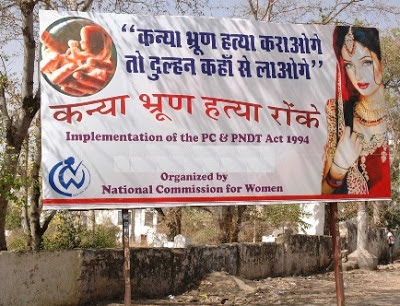
2. PC & PNDT Act 1994:  Pre-natal Diagnostic Techniques (Regulation and Prevention of Misuse) Act, 1994 to curb this practice and brought into operation from 1st January, 1996. PNDT Act and Rules have been amended keeping in view the emerging technologies for selection of sex before and after conception and problems faced in the working of implementation of the ACT and certain directions of Honorable Supreme Court. These amendments have come into operation with effect from 14th February, 2003.
As per PC & PNDT Act 1994: 
A. No Genetic Counseling Centre, Genetic Laboratory or Genetic Clinic unless registered under this Act, shall conduct or associate with, or help in, conducting activities relating to pre-natal diagnostic techniques.
B. No Genetic Counseling Centre, Genetic Laboratory or Genetic Clinic shall employ or cause to be employed any person who does not possess the prescribed qualifications;
C. No medical geneticist, gynecologist, pediatrician, registered medical practitioner or any other person shall conduct or cause to be conducted or aid in conducting by himself or through any other person, any pre-natal diagnostic techniques at a place other than a place registered under this Act
3. Protection of Woman from Domestic Violence Act 2005: An Act to provide for more effective protection of the rights of women guaranteed under the Constitution who are victims of violence of any kind occurring within the family and for matters connected therewith or incidental thereto. The Protection of Women from Domestic Violence Act 2005 differs from the earlier law, Section 498A of the Indian Penal Code, in that it explicitly defines domestic violence in addition to dowry-related cruelty. omestic violence is defined as follows:
For the purposes of this Act, any conduct of the respondent shall constitute domestic violence if he:
(a) habitually assaults or makes the life of the aggrieved person miserable by cruelty of conduct even if such conduct does not amount to physical ill-treatment; or
(b) forces the aggrieved person to lead an immoral life; or
(c) otherwise injures or harms the aggrieved person.  
4. National Commission for Woman: The National Commission for Women was set up as statutory body in January 1992 under the National Commission for Women Act, 1990 ( Act No. 20 of 1990 of Govt.of India ) to :
A. review the Constitutional and Legal safeguards for women ;
B. recommend remedial legislative measures ;
C. facilitate redressal of grievances and
D. advise the Government on all policy matters affecting women.
In keeping with its mandate, the Commission initiated various steps to improve the status of women and worked for their economic empowerment during the year under report.  The Commission completed its visits to all the States/UTs except Lakshdweep and prepared Gender Profiles to assess the status of women and their empowerment.  It received a large number of complaints and acted suo-moto  in several cases to provide speedy justice.  It took up the issue of child marriage, sponsored legal awareness programmes,  Parivarik Mahila Lok Adalats and reviewed laws such as Dowry Prohibition Act, 1961, PNDT Act 1994, Indian Penal Code 1860 and the National Commission for Women Act, 1990 to make them more stringent and effective.  It organized workshops/ consultations, constituted expert committees on economic empowerment of women, conducted workshops/seminars for gender awareness and took up publicity campaign against female foeticide, violence against women, etc. in order to generate awareness in the society against these social evils. Rastra Mahila .. newslatter published By NCW in Hindi as well as English.
5. Constitutional Provision for Woman: 
Article 14: Equality before law
Article 15: Prohibition of discrimination on grounds of religion, race, caste, sex or place of birth
Article 16: Equality of opportunity in matters of public employment
Article 21: Protection of life and personal liberty
Article 23: Prohibition of traffic in human beings and forced labour
Article 39: Certain principles of policy to be followed by the State
Article 42: Provision for just and humane conditions of work and maternity relief
Article 45: Provision for free and compulsory education for children

e-GRAS in Rajasthan


e-GRAS in Rajasthan: e-GRAS stands for Government Receipts Accounting System. e-GRAS is an online Government Receipts Accounting System. The departments which generate revenue for the Government are associated with eGRAS. To participate in e-GRAS one has to click on new user creation and requires to fill up their credentials. Once the login ID is generated then one is authorised to use eGRAS for all types of challan submission.

Take a look on e-GRAS: Government Receipts Accounting System Application.